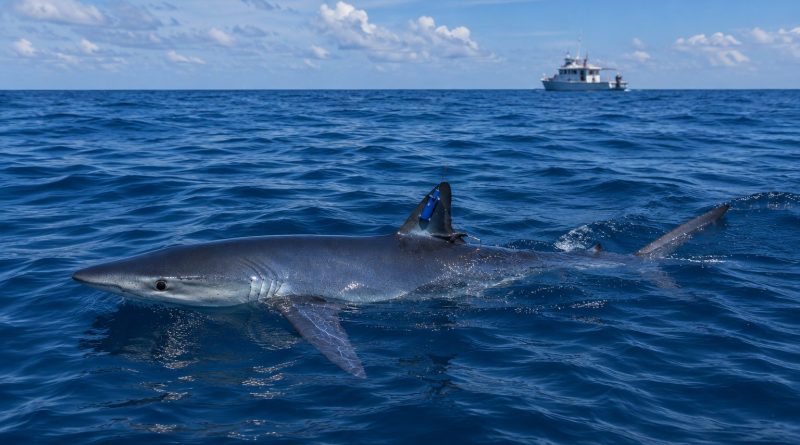
Sharks become the ocean’s “living weather stations”: scientists learn to predict climate using predators
Imagine a shark that is not only hunting in the depths of the Atlantic Ocean, but also collecting valuable data for climate scientists at the same time. That is exactly what researchers at University of Miami have achieved — and the results are already being called a breakthrough in oceanography.
Scientists have discovered that satellite sensors attached to sharks can significantly improve ocean forecasting and even help researchers better understand climate change.
In 2021, a team of scientists fitted 18 sharks in the Northwestern Atlantic with satellite tags. The study focused on blue sharks and shortfin mako sharks — species known for their long migrations and ability to dive to extreme depths.
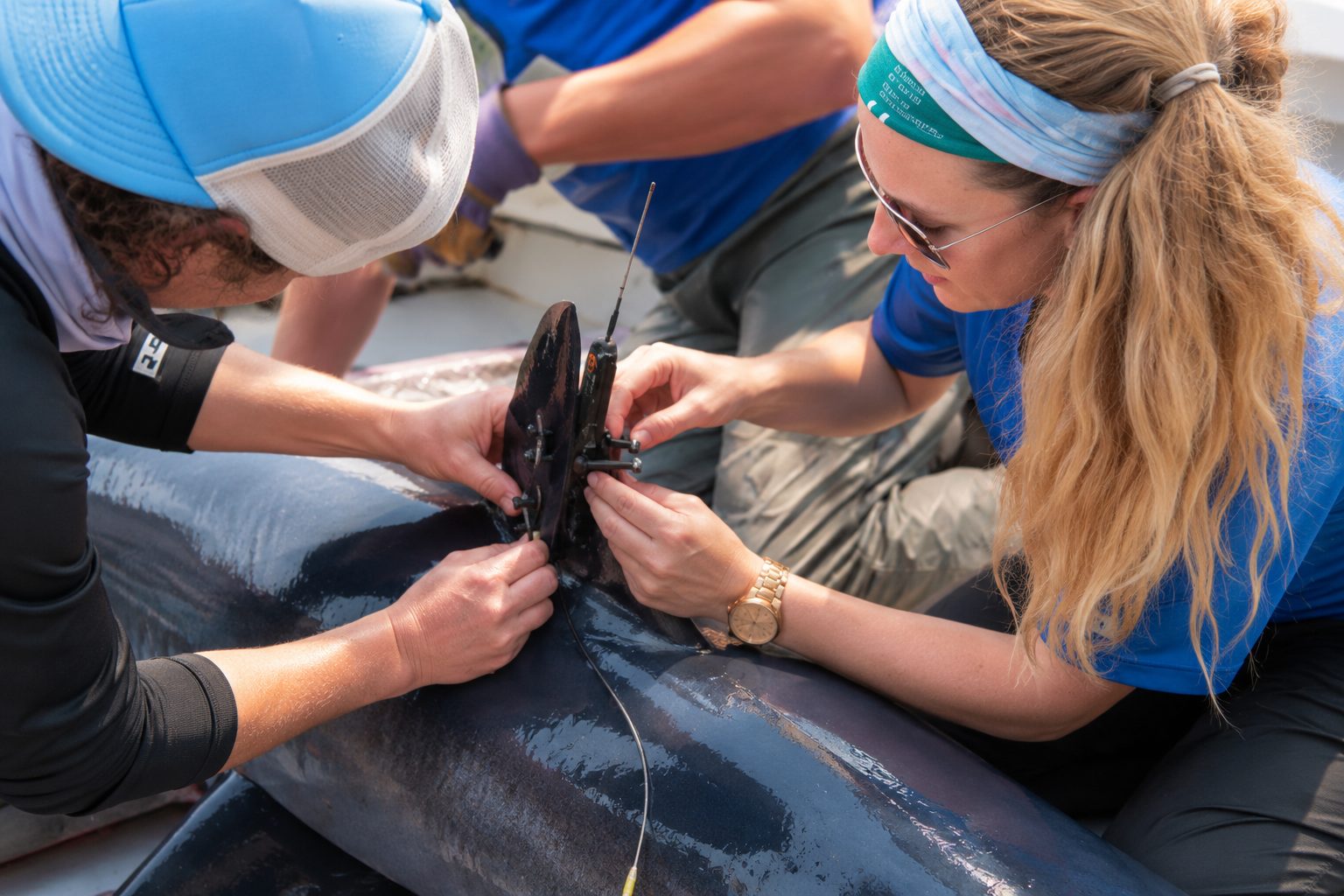
Blue sharks were especially impressive: they can dive deeper than 1,000 meters, moving through layers of water with temperature differences of up to 20°C. During these journeys, the sensors recorded water temperature, depth, and pressure.
In effect, the sharks became autonomous mobile laboratories, gathering data in places that research vessels and ocean buoys rarely reach.
“Sharks are already moving through parts of the ocean that are difficult for humans to observe. Their data helps fill critical gaps in climate models,” explains lead researcher Laura McDonnell.
Over the course of the study, the sharks transmitted more than 8,200 temperature-depth profiles, some collected from depths approaching 2,000 meters.
Researchers integrated this information into one of the world’s leading climate models — the Community Climate System Model — which is used to forecast future climate conditions.
The results were remarkably strong:
- surface ocean temperature forecast errors were reduced by up to 40%;
- forecasts improved significantly in coastal and rapidly changing regions;
- model accuracy increased in ocean fronts and eddy zones — some of the most difficult areas to monitor.
Why does this matter?
Because even small improvements in ocean forecasting can have a major impact on:
- fisheries;
- coastal communities;
- marine logistics;
- climate risk management;
- ecosystem monitoring.
According to study co-author Camrin Braun, reducing uncertainty allows scientists, governments, and industries to manage marine resources more effectively and respond faster to changing ocean conditions.
This study became the world’s first example of integrating data collected by marine animals into seasonal climate models.
Scientists believe that in the future, similar technologies could be used not only with sharks, but also with tuna, sea turtles, rays, and even whales.
In many ways, nature itself is providing researchers with the perfect “data couriers” — animals that travel thousands of kilometers every day and dive into places that are difficult and expensive for humans to reach.
Researchers emphasize that sharks will not replace traditional observation systems such as satellites, buoys, and research vessels. However, they can complement existing networks with unique data from remote and hard-to-access regions of the ocean.
And perhaps, these marine predators may ultimately help humanity better understand how Earth’s climate is changing.